What we see most
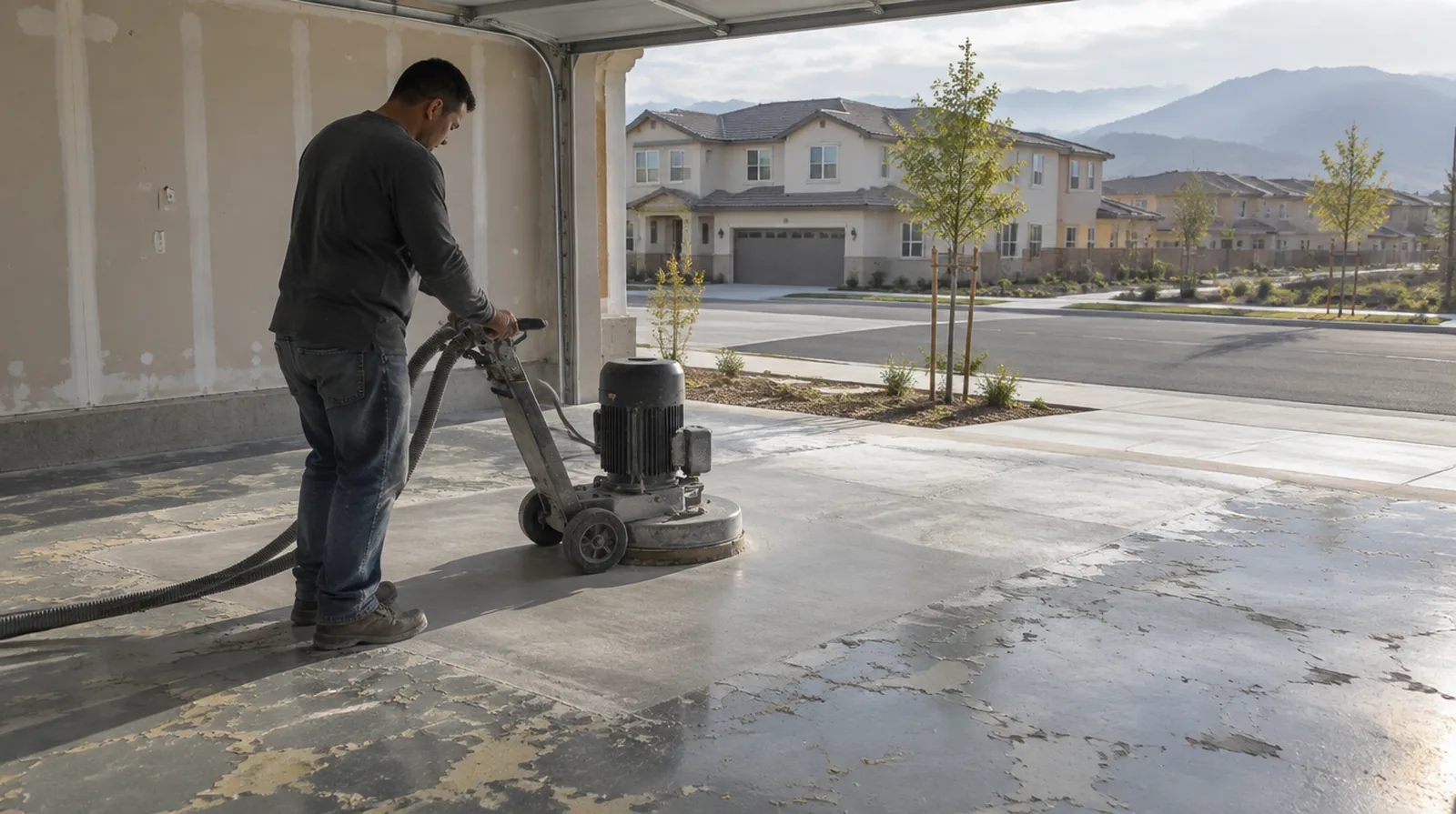
Many Eastvale garages have store-bought kits that started lifting where the car tires sit. Others have bubbles from moisture or worn spots in front of the workbench.
Our repair steps
1. Find the cause: poor bond, moisture or wear.
2. Remove loose or failing coating.
3. Grind and patch the concrete.
4. Recoat with a full system.
A better finish
After repair, many owners pick a flake floor because it hides small imperfections.
Can you fix just one area?
Sometimes, but it may not match the rest. We will tell you up front.
Why did my kit fail?
Usually because the concrete was not ground.
Moisture under the coating
Newer slabs can still push moisture up, especially near planters or where sprinklers hit the outside of the garage wall. That moisture can cause bubbles or white haze under a coating. We test for it and use a moisture-tolerant primer when needed.
Hot tire pickup
When a hot tire sits on a weak coating, it can pull the coating off. A proper grind and quality topcoat stop that from happening.
Repairing coatings in newer Eastvale homes
Many Eastvale garages had their first coating put on soon after move-in, sometimes with a DIY kit that was never ground in. Epoxy floor repair in Eastvale often means fixing those coatings where they peeled under hot tires or lifted along the garage door. We also see floors damaged by moisture coming through slabs near sprinklers and planters.
How we repair
We test bond strength, mark loose areas, cut back to solid coating, and grind the edges. If moisture is involved, we use a primer designed for it. Then we rebuild the layers and can add a full clear coat to blend the repair.
Repair questions
Do repairs come with a guarantee? We explain what we stand behind in the written quote.
Can you change colors? Only with a full recoat.
How long does it take? Usually a day or two.
Can moisture problems be prevented? Adjusting sprinklers and planters near the garage helps a lot.
Fixing hot tire marks
Hot tires can soften thin coatings and pull them up. We rebuild with a thicker system that resists this.
After we leave
Use hot tire pads in summer and wipe spills promptly to keep the repaired floor sharp.
Hairline cracks and why coatings let go along them
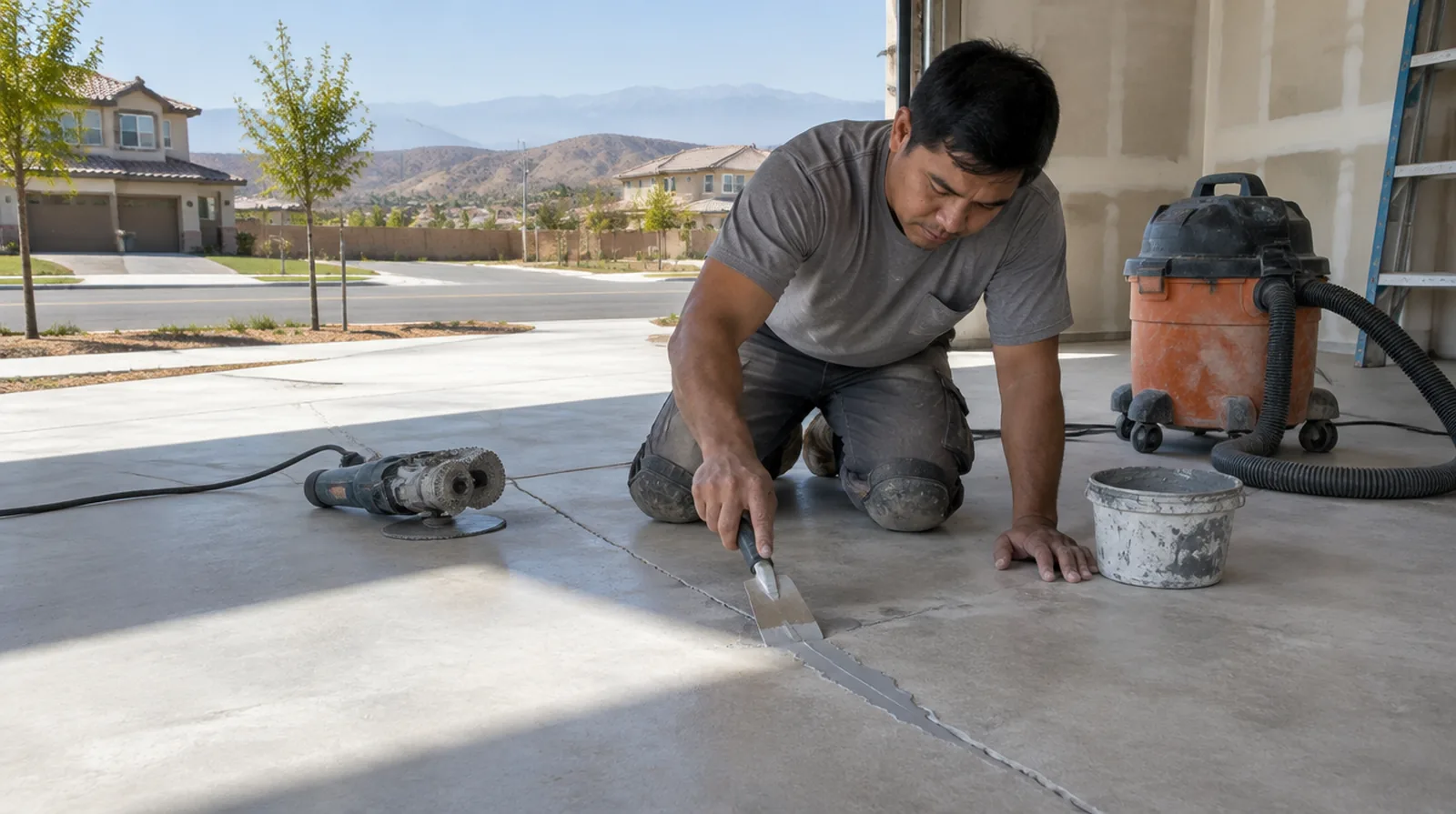
Newer slabs in Eastvale often look smooth, but many have thin shrinkage cracks that formed as the concrete cured. Some are barely visible on bare concrete. Once a coating goes over them, especially a thin kit product, those lines can show through and eventually lift. When owners call us about a floor that is peeling in long, straight strips, a hidden crack is often the cause.
How a crack telegraphs through
Concrete moves a little with temperature. A crack opens slightly on a hot day and closes at night. A rigid coating stretched over that line will eventually split along it. If the crack was never filled, water and dirt get under the edge, and the coating starts to peel back from there.
Our repair approach
We grind off the loose material on each side of the crack until we reach well-bonded coating or clean concrete. The crack itself is opened slightly with a grinder blade, vacuumed, and filled with a repair compound suited to its width and how much it moves. Once the filler cures, we grind it flush, feather the edges of the old coating, and rebuild the area so the patch blends in.
Control joints are different
Saw-cut control joints are meant to move. We do not fill them rigid and hope for the best. Depending on the floor, we use a flexible filler or honor the joint line in the new coating so it can move without tearing the finish.
When a full redo makes more sense
If cracks and peeling cover a large share of the floor, spot repairs can end up costing close to a new system and still look patchy. We will tell you plainly which path we think fits your garage.
Will the repaired line show? On a solid color it may be faintly visible up close. Flake floors hide repairs best.
Fix your failing floor
Call (951) 330-3293 for a repair estimate.